Alfavet
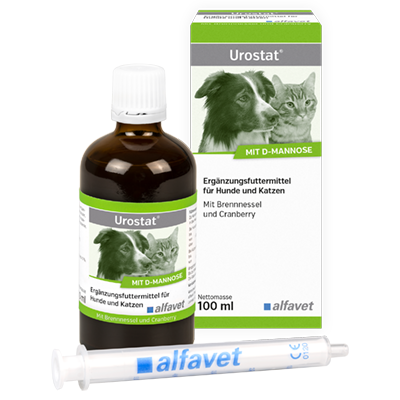
Urostat sirup protiv cistitisa za pse i mačke, 100 ml
Urostat sirup protiv cistitisa za pse i mačke, 100 ml
Učitavanje dostupnosti preuzimanje nije moguće
Urostat syrup is a support for urinary tract infections in dogs and cats and helps reduce the risk of recurrent infections. It is used in acute and chronic cystitis and after catheterization.
Dosage:
Dogs up to 10 kg body weight: 1 ml twice daily
Dogs from 10-20 kg body weight: 2 ml twice daily
Dogs over 20 kg body weight: 3 ml twice daily
Cats up to 5 kg: 0.5 ml twice daily
Cats from 5-10 kg: 1 ml twice daily
The recommended period of use is up to 8 weeks, on average 10-14 days. If necessary, use can be repeated.
The syrup is measured with the attached syringe and given directly into the mouth or mixed with food. After use, the attached syringe is washed.
Composition: D-mannose 10%, sugar beet syrup, glucosamine 2%, (dried nettle leaves, horsetail, goldenrod, lavender, black currant, cranberry) macerate 2%, cranberry, ground 0.5%, phytosterols, goldenrod, ground 0.1%, horsetail, ground 0.1%.
Analytical constituents: crude protein 0.8%, crude oils and fats 0.9%, crude fiber 0%, crude ash 1.2%, moisture 81.8%. Urostat does not contain oxalic acid.
Additives per 1000 ml: Vitamin A 12 000 IU.
D-mannose is a simple sugar with antibacterial properties. It prevents bacteria from attaching to the bladder wall.
Glucosamine provides protection (mechanical resistance) by strengthening the inner lining of the bladder, which consists of GAGs, which prevents bacteria and crystals from attaching to the bladder wall, reduces the permeability of the bladder wall and prevents the passage of harmful substances through the urothelium, thus preventing the development of infections.
Cranberry is rich in vitamin C and antioxidants. It contains proanthocyanidin PAC A2, trimers PAC B2, 3-PAC, which bind to the surface receptors of pathogenic bacteria and prevent their adhesion to the urinary tract endothelium. The anti-adhesive properties of cranberries prevent the colonization of the bladder by pathogenic bacteria responsible for chronic urinary tract infections (Escherichia coli). Its acidifying ability (contains malic acid, citric acid and quinic acid) provides additional aseptic properties. It is also useful as a urine deodorizer, as it neutralizes ammonia.
Herbal ingredients from nettle (Urtica dioica), goldenrod (Solidago virgaurea), field horsetail (Equisetum arvense) and black currant (Ribes nigrum) support and protect the urinary tract, have an anti-inflammatory effect, reduce irritation in the urinary tract and increase urine excretion.
Udio